
Member Spotlight: Mohamad Abedi is designing a new language for cellular communication
The molecular messengers Dr. Mohamad Abedi designs have never existed in nature. Cells respond to them anyway.
Using AI-driven computational protein design and synthetic biology, his lab creates new cytokines — signaling proteins cells use to communicate — to uncover and rewrite the rules governing cellular behavior.
The goal is to build tools that can steer cells from one state to another, such as turning a dysfunctional immune cell into an effective one or shifting a degenerative cellular environment toward repair.
Here, he talks about the questions driving his new lab, the path that took him from community college and aerospace engineering to synthetic biology, and why his happiest moments often involve an unfamiliar cuisine.
Abedi joined the UCLA faculty in July as an assistant professor of bioengineering at the Henry Samueli School of Engineering and Applied Science.
Tell us about your research.
My research starts with a fundamental idea: cells communicate through molecular messages, and one important class of those messages is a family of proteins called cytokines — the word comes from Greek roots meaning "cell" and "movement" (cyto = cell; kines = moving). You can think of cytokines as words in the language cells use to talk to each other.
Historically, we've studied this language by discovering the words nature made and asking what each one does. But nature only evolved the vocabulary it needed for biological systems that already exist. In diseases such as cancer or degenerative conditions, it may be useful to expand that vocabulary — to create entirely new cytokines, understand their grammar, and eventually arrange signals into sentences rather than simply shuffling existing words around.
Creating new protein “words” was almost impossible just a few years ago, but recent advances in AI-driven computational protein design allow us to generate entirely new proteins.
My lab is using those tools to design new cytokines — and surprisingly, many of them work. We want to understand why that is, why nature did not make them and whether they let us do things that the natural vocabulary cannot.
We're especially interested in cell fate: what signals can move a dysfunctional immune cell into an effective state or shift a pro-inflammatory environment toward repair. We're building a toolkit of natural and designed proteins to answer those questions and, ultimately, control cell fate more precisely.
Our lab is actively recruiting at all levels. If you're interested in our research, please visit our website for more information.
Have you always wanted to be a scientist?
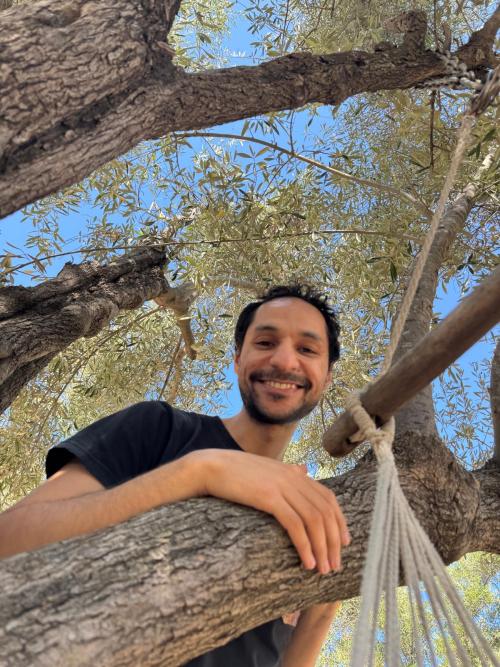
No, not at all. My family and I immigrated to the U.S. when I was 17, and my version of the American dream was very simple: you come here, get an education, get a job and make a stable life. I started at Irvine Valley College and later transferred to UC Irvine. My immigrant parents encouraged three career paths: medicine, engineering, or law. I initially chose mechanical and aerospace engineering, then switched to biomedical engineering to bridge engineering and medicine.
What attracted me to engineering was my fascination with outer space and our ability to engineer systems that allow us to see and explore that vast, mysterious world. But while one of the biggest mysteries we face lies outside our planet, another exists inside us — in our cells and genomes. I was drawn to the macro and the micro, and the micro somehow won.
As an undergraduate working in research labs, my mentors gave me almost unlimited freedom to work on different projects. That exposed me to synthetic biology and the idea that we could do more than observe biology; we could rebuild it in ways that didn’t exist before. I realized my role could be not only to learn what is already known, but to create new possibilities. That was what made me fall in love with research.
What drew you to the UCLA Broad Stem Cell Research Center?
The center gives me access to collaborators with complementary technologies and expertise. Dr. Dino Di Carlo’s high-throughput technologies can help us move from testing a few hundred proteins at a time to testing tens of thousands. I’m also exploring exciting directions with center director Dr. Thomas Rando to understand how muscle cells choose between renewal and atrophy with aging — and whether we can reverse signaling networks that push tissue toward degenerative rather than regenerative states.
What motivates you to pursue your research?
I love working on an idea that is barely believable and then making it real.
More and more, I’m excited to see these outlandish ideas move toward direct translational applications. When synthetic biology and computational protein design were younger fields, much of the appeal was intellectual: the ideas were exciting, but it felt like a long road to using them in people. Now we’re seeing that these approaches can create functions we simply couldn’t access before and open new paths to therapies.
Where and when are you the happiest?
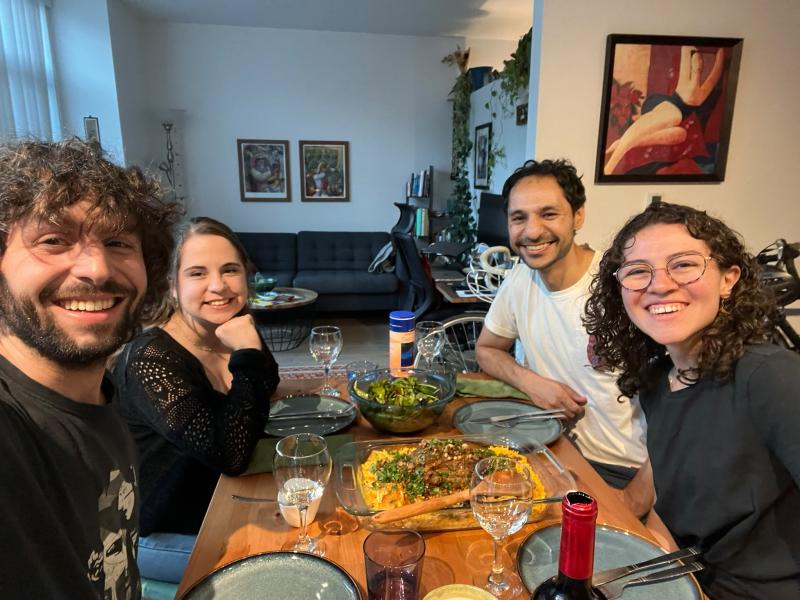
I love exploring new foods. It started as a birthday ritual: every year, my one requirement was that we try a cuisine I had never tried before. That is probably connected to my obsession with Anthony Bourdain. What I loved about his philosophy was the idea that food is much more than the calories we need to get through the day — it can be an entryway into a culture, the surrounding environment and the lives of the people who live there.
You learn a lot from what people eat: what ingredients are available to them and how they’ve learned to use them, what they turned to when food was scarce, and how many illnesses grandmothers can apparently cure with olive oil. It becomes much more than just eating a meal; it is a way of understanding people and their stories. And Los Angeles is a very good place to keep exploring.
What’s something most people might not know about you?
I didn’t have citizenship in any country until I was around 21. As the child of Palestinian refugees, I was also born with refugee status, reflected on my United Nations identification card — also known as the “blue card,” which, needless to say, is probably not on anyone’s top-five passport list.
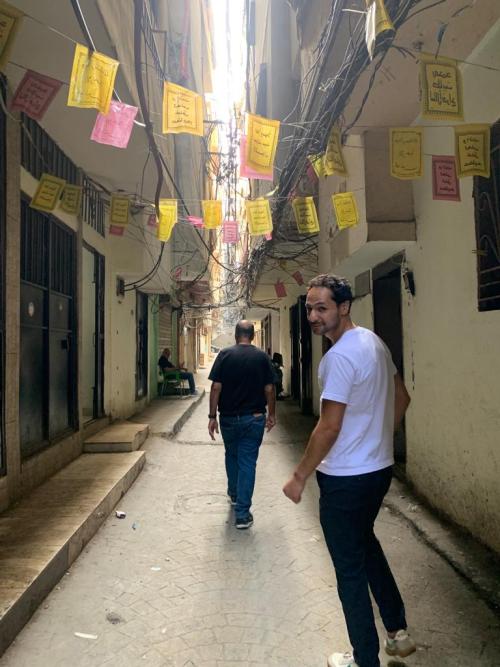
In retrospect, I’m very grateful for having grown up in those circumstances because they strongly shaped how I see the world. Through years of my parents’ hard work and planning, I was fortunate to have the opportunity to immigrate to the United States and eventually discover what it meant to pursue a passion beyond simply building a stable life.
I’m very aware that this opportunity is not available to many people around the world, or even to many people here in the United States. That has become one of my core values as an educator, and a major reason I chose this profession and this city: to play a role in creating those opportunities for others and help unlock the enormous amount of potential that might otherwise go unrealized.
What’s one thing you wish more people knew about science?
That anybody can be a scientist. I think it comes down to two things. First, you need to be genuinely curious and excited to learn more about something. That curiosity is what sustains you.
Equally important, you need the right environment — mentors and a community that open paths for you. I was able to become a scientist because I had amazing mentors at every stage who invested in me, answered my questions and exposed me to this path.
For students who are finding their way, especially those who don’t already have those networks, I would say: don’t decide in advance what you can or can’t do. Take the first step and try. Then find and build communities around you. There are many research groups filled with people who are genuinely excited to help others find a place in science and build things together.
Meet the Researchers

- Assistant Professor, Bioengineering