
A walk around the park
Some are already calling it “the hive.”
That’s because within two years, the UCLA Research Park, currently under construction within the former Westside Pavilion mall on Pico Boulevard, will be buzzing with busy Bruins and their very practical ideas surrounding a very audacious idea: changing the world. “The ‘hive’ is a tremendous vision for the Park: It captures the creative energy and electricity that we expect the community to generate,” says Hal Monbouquette, professor of chemical and biomolecular engineering at the UCLA Samueli School of Engineering and special advisor on the Park to Roger Wakimoto, UCLA’s Vice Chancellor for Research & Creative Activities.
The idea of university-led research parks — facilities shared by academic, public and industrial inventors — was born in California (where else?) in the early 1950s. There are now around 200 such parks across the country, and their research has produced breakthroughs ranging from GPS and genetic fingerprinting to cancer cures and COVID-detecting nose swabs.
“Because of our space constraints, this will be different from the sprawling parks in the Midwest and the South,” Monbouquette advises.
But, with Bruin brainpower behind it, it will be no less impactful.
“No walls”
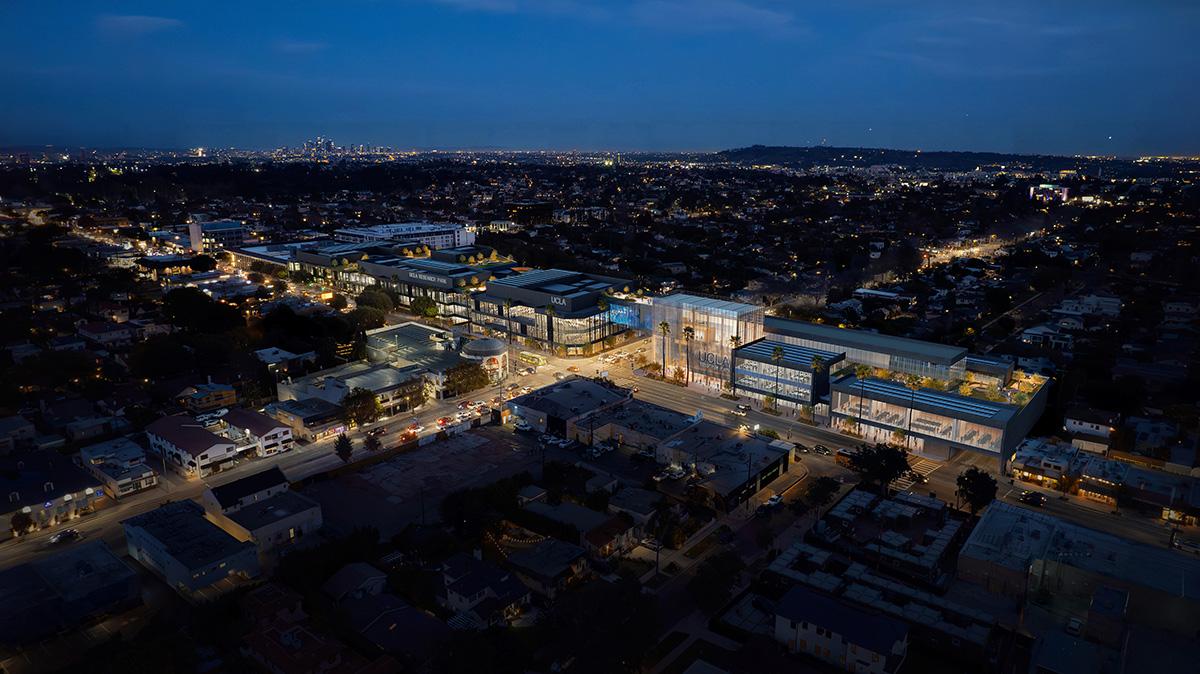
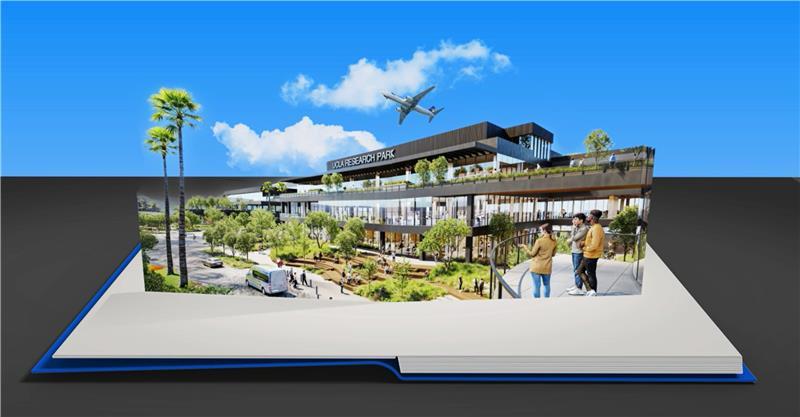
Two miles south of campus, the space once occupied by luxury retailer Nordstrom, cinema chain Landmark Theaters and multiple stores and eateries clocks in at 700,000 square feet — the equivalent of 12 football fields. That’s a lot of room for scientific innovation. The Wisconsin-based firm Flad Architects has drawn up a vision of a green complex for which the phrase “state of the art” might have been invented. The goal, above all else, is to allow people to connect and share — not always a top priority in research park design.
After UCLA acquired the site, many saw the Park as a potential storage facility for old lab equipment; while others considered it a conventional expansion. Neither is correct. “This is something very new for UCLA,” Monbouquette says.
The university has not had private companies operating on its main campus since Monbouquette arrived at UCLA almost 40 years ago. He says it has sometimes been a challenge to collaborate with businesses to develop joint intellectual properties, although with the UCLA Technology Development Group (which strikes intellectual property deals between the university and outside interests), things have gotten better in recent years. “Working side by side with companies and public agencies at the Park, no walls between us,” he says, “will be an enormous change with benefits for our students, the university and Los Angeles.”
Traditionally, scientists work on small teams deeply focused on narrow but important projects. Within the hive, Monbouquette says, “there will be no such walls — everyone will be working together to create a new generation of multidisciplinary translational [from lab to market] research, always with one eye on how this research will result in a product that will benefit society.”
“One of the first relocators from the main campus to the Park will be the Quantum Innovation Hub, probably in late 2027,” says Jason Petta, a professor of physics in the UCLA College and director of the Hub. “The Hub will start with labs across 40,000 square feet in the basement — prime real estate.” The plan is for it to triple in size over the next decade.
The hive has big ambitions for its space. It’s hardly alone.
Quantum Leap
To the general public, quantum science seems mysterious, with chasing invisible particles the ultimate blue-sky project. But Petta and his Hub co-director, Professor of Electrical and Computer Engineering Chee Wei Wong, have practical stratagems in sight by working with Park partners to create a pool of quantum bits, or “qubits.” The simplest way to put it (and we realize this is still not so simple): Today’s quantum computers use lasers, electromagnetic fields and near-zero temperatures to “spin up,” or control, tiny bits of information that together can work like today’s electronic transistors, processing data at superfast speeds. “To create a practical quantum computer, you need millions of qubits — but even the biggest concerns only have, maybe, 100,” Petta says.
Enter Malibu-based company HRL Laboratories, formerly Hughes Research Laboratories, which in 1960 built the very first laser. HRL is one of the Hub’s first collaborators at the Research Park. “HRL and my research team at UCLA are developing semiconductor spin qubits,” Petta says. “The idea is to make qubits that are compatible with conventional semiconductor processing techniques, such that we have a realistic pathway for reaching the millions of qubits required for practical quantum computing. Today, it’s possible to make semiconductor chips with 100 billion classical transistors. Our goal is to make millions of quantum transistors.”
Another potential Park partner is Boeing, which sees qubits as the way to substantially improve satellite security for mobile phone networks. “We want the research to have a practical benefit to society as a whole,” Wong says.
Ready to Move
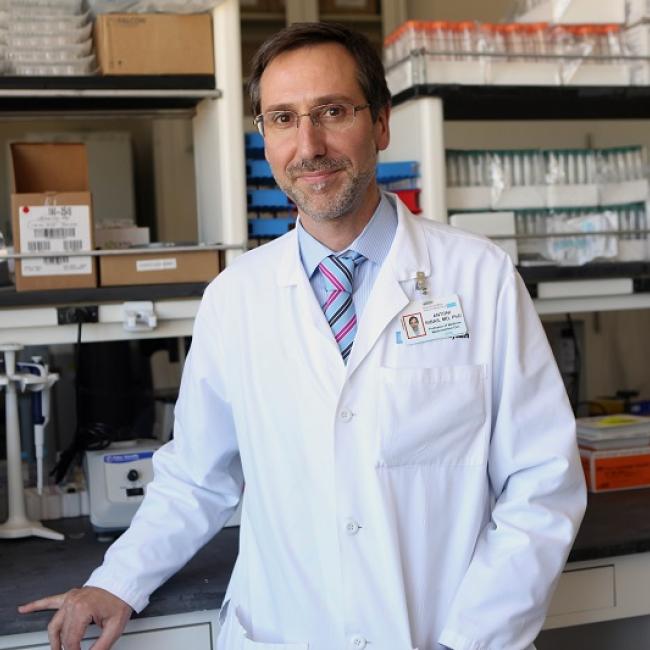
Among researchers already revving up for the move into the new facilities, Antoni Ribas has been at the forefront of arguably the most promising development in modern cancer research: efforts to engineer the body’s immune defenses to fight the deadly disease. In 2014, his team — consisting of researchers from 16 countries — published a landmark study showing the effectiveness of the immunotherapy drug pembrolizumab (since marketed under the brand name Keytruda) in treating advanced melanoma, an aggressive and often fatal form of skin cancer once considered untreatable. The drug has since been approved for use with multiple types of cancer.
“For many years, people didn’t think cancer immunotherapy was possible,” says Ribas, a UCLA professor of medicine, surgery, and molecular and medical pharmacology. “But as the science evolved, it became clear we could unleash the power of the immune system to treat cancer by releasing its brakes. And once the immune system does something, it remembers and can attack the cancer again if it tries to come back.”
Researchers have also demonstrated — with another set of cancers — the ability to generate immune cells in the laboratory from the patient’s own blood and redirect them so that, when returned, they can effectively fight the disease. “We’re in an exciting time where these types of treatments will continue to improve,” Ribas says.
At UCLA Research Park, his team will join UCLA clinical and biomedical scientists across a range of disciplines as part of the California Institute for Immunology and Immunotherapy (CIII). This new institute that will bring together researchers with an interest in deploying the immune system to fight diseases in which it is known to play a role — infectious, autoimmune, cardiovascular and neurological among them.
Ribas anticipates his own hive of activity within the institute, one where common areas can be used for seminars and meetings and where chance hallway encounters can foster fruitful, and potentially lifesaving, exchanges. “When you have a confluence of people working on a big issue from all sides, that’s when truly innovative things occur,” he says. “Working in isolation, we miss a lot of opportunities.”
CIII and the UCLA Research Park as a whole promise not just a melding of diverse scientific minds, but also a mission-driven culture, with basic scientists joining with industry experts to create a nexus for discovery and innovation. “A lot of the drug development over the last 15 to 20 years has happened in industry, but the basic discoveries typically have come from academic laboratories,” Ribas says. “With the new space, we’ll be able to go from an idea to the development of therapeutics for patients by using platform technologies that help investigators get through the bottlenecks.”
Mining the Microbiome
“For those of us who are trained as academics or physicians, typically you make the discovery and then expect others to bring it to market,” notes Associate Professor Elaine Hsiao ’06, holder of the Goodman-Luskin Chair in Microbiome Research. “The commercialization process requires a different mindset and skill set. And being able to receive input from people on the development side at an earlier point in our research will be incredibly useful.”
As director of UCLA’s Goodman-Luskin Microbiome Center (GLMC), founded in 2022, Hsiao is leading a campuswide effort to probe the human microbiome — the trillions of microbes that inhabit the body, with profound implications for our health and behavior. As Hsiao and her GLMC colleagues learn more about microbes and the signaling pathways that play a role in metabolic, psychiatric, immunological and other types of disorders, they’re identifying targets for dietary and medication strategies that both thwart disease and promote better wellness.
The project is a monumental undertaking, one that calls for teams of scientists bringing diverse perspectives and expertise. At last count, GLMC had more than 80 members, hailing from more than two dozen UCLA departments and divisions. “We are currently fueled by faculty with labs spread around the entire campus,” says Hsiao, whose own research probes how the biomolecules produced by gut bacteria influence neurodevelopment, neurological functioning, and gastrointestinal and neurological conditions. “Having a centralized location where we can share meeting and lab space will make a big difference.” Beyond the Park’s immediate benefits for current team members, Hsiao foresees a boon in recruiting, particularly given the limited real estate on the main campus.
“We’re continuing to recruit faculty to the GLMC who bring additional expertise and expand our capabilities,” she says, “and we need space for them.”
Challenges remain. Creating a cultural and logistical “umbilical cord” between the Research Park and the UCLA campus will be critical, says Monbouquette. And there may still be questions arising from the state-mandated CEQA environmental review, which will recommend ways of dealing with new traffic flow.
And then there is future fundraising. Monbouquette admits some of the state-of-the-art facilities could be “eye-wateringly” pricey. But the prospect of a fresh paradigm in teaching and learning — and the potential for enormous scientific, health and research benefits for Los Angeles and the world — well, that, he says, “is the kind of vision we share at UCLA.”
Meet the Researchers
- Professor, Hematology/Oncology