
How to bring heart into tech
A professor of bioengineering and mechanical and aerospace engineering at the UCLA Samueli School of Engineering, Dino Di Carlo seeks two things: innovation and impact. As chair of the bioengineering department, he is constantly exploring new frontiers in microfluidics, “lab-on-a-particle” technology, and single-cell analysis. But Di Carlo, a prolific inventor and entrepreneur, has even loftier aspirations: He aims to build personal, human connective tissue between medical technology and the people who benefit from it. He’s helped launch multiple biotech ventures — such as the one that created the IntelliSep test for sepsis — that are advancing the way patients receive care.
Here, he talks about his definition of connection, the one question he asks before every new project, and the gift a mentor once gave him that he never forgot.
This issue of UCLA Magazine is all about UCLA Connects. What does “connection” mean to you?
My career has been about connecting what students are learning and the work they’re doing — whether in the classroom or in the lab — to its impact on the community and patients, so they understand that their work is valuable. Solving a differential equation or pipetting in the lab in the late hours can seem like a slog. But I try to show them how that can connect to people.
What do you hope your students take away?
That it can take decades of work to build something that will eventually end up helping people. We need to have empathy, starting at the earliest stages. You have to make connections with people so that you can be motivated for those long years. Take the IntelliSep tests. In 2024, I visited a doctor who was one of the first to use it. Just hearing the stories of how it helped patients made me feel like the decade was worth it. I tell those stories to my students.
I’m sure those stories are really powerful. How else do you help students understand the human stakes of engineering?
Almost all of our students do undergraduate research. It’s so important that they get a taste of the real world, which has open-ended problems without solutions. As a student, you don’t want to answer a question that everyone knows the answer to; it doesn’t help you feel like you’re impacting the world.
Is that something you yourself experienced?
I started doing research in a lab as an undergraduate freshman at UC Berkeley. My mentor, Luke Lee, gave me a lot of freedom to explore, which was so valuable. You’re not listening to someone else’s idea. You’re getting there yourself by meeting with primary sources and integrating all the information. I try to pass that lesson on to my mentees: Don’t tell me someone else said this is the right thing to do; tell me why you believe it.
How do you balance pushing the boundaries of technology with keeping the work grounded in human needs?
At the earliest stages of building new technologies, I always ask, “Who is this going to help?” That’s a hard question to answer sometimes, because we don’t know all the information. That’s where making connections and talking to people comes in. Whether it’s clinicians or scientists, we need to understand their needs and the bottlenecks or struggles they have.
Given that, what role does bioscience play in connecting people across disciplines on campus?
You need teams of people with different skill sets and backgrounds — clinicians, chemists, engineers, folks in public health — who can work together to tackle really complex problems. And the bioscience aspect is a bridge for those people. In the end, once we can understand the complexity of life, we can improve human life. That’s the shared goal.
Meet the Researchers
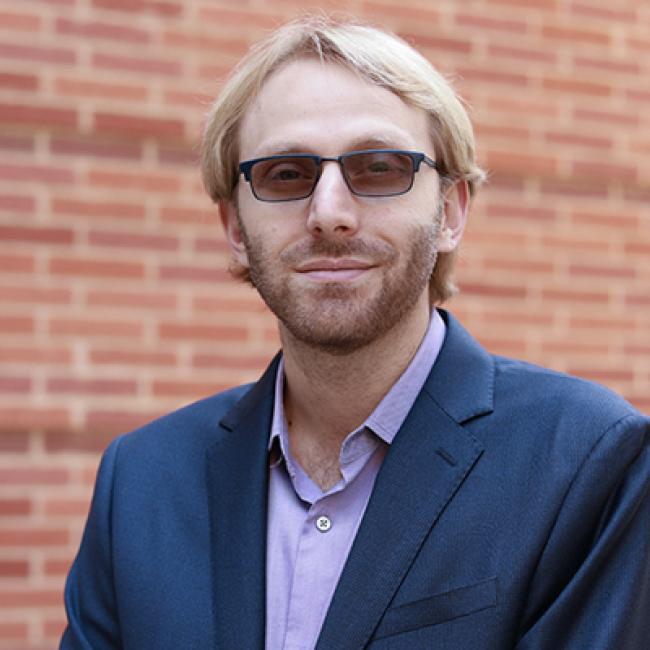
- Armond and Elena Hairapetian Professor and Chair, Bioengineering