
Meet the doctor building tiny tools for big science breakthroughs
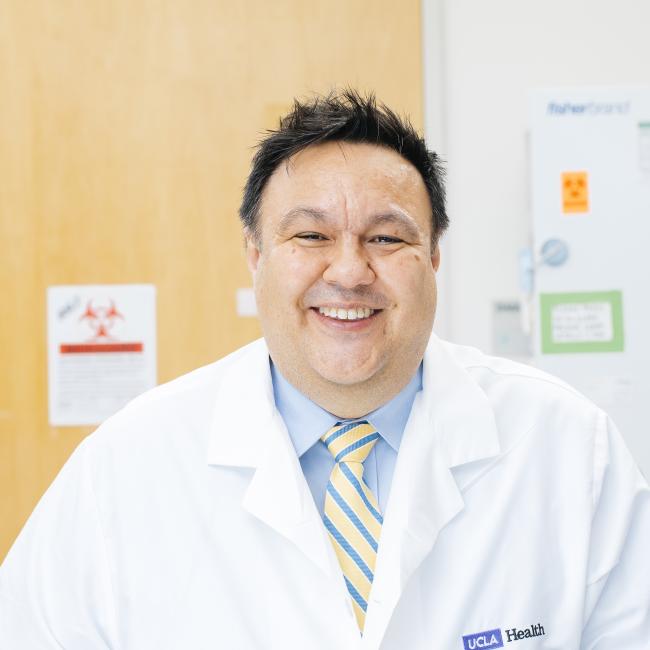
Dr. Steven J. Jonas, assistant professor in the department of pediatrics at the David Geffen School of Medicine at UCLA, also holds an M.D. and a Ph.D. in materials science and engineering from UCLA. As a physician-scientist and associate program director of UCLA’s Pediatric Hematology/Oncology Fellowship Program, he treats children with blood disorders and different types of cancers.
Working at the intersection of science and medicine, Jonas runs a laboratory on campus where he uses nanotechnology to explore cancer and other disease-fighting tools for his patients. On any given day, you may find him performing a bone marrow transplant, counseling a family searching for answers or in his lab thinking about emerging cellular and gene therapies.
Jonas is also a member of the UCLA Health Jonsson Comprehensive Cancer Center, the Eli and Edythe Broad Center of Regenerative Medicine and Stem Cell Research at UCLA and the California NanoSystems Institute at UCLA.
Newsroom sat down with Jonas to learn more about him and how he changes lives. This interview has been edited for length and clarity.
When did you first start thinking about becoming a doctor?
In high school, I was nominated for the National Youth Leadership Forum in medicine and healthcare. It’s considered a “pre-med” bootcamp for high schoolers, and participants have the option to visit different places across the United States. I landed in the Bay Area in an immersion program, trying out biotech companies and labs, and listening to speakers and deans at universities. That set me on the path toward medicine — and since medical school is tough to get into, I majored in engineering at the University of Michigan.
During college, I spent some time at Corning and Johnson & Johnson and realized there was a niche I could fill: Doctors need tools, and they typically seek out scientists and engineers when they need them to advance medicine and knowledge. Doctors, scientists and engineers speak very different languages, so I thought it would be amazing if I could contribute to that discussion by learning how to be clinically and scientifically “multilingual” and translate between these disciplines. At the end of my college journey, I decided to apply for M.D./Ph.D. programs and ended up earning both here at UCLA.
Why did you choose pediatrics and specifically, pediatric oncology?
Taking care of children and guiding them through one of the toughest journeys they’ll ever face is what it’s about for me. I had always thought that pediatrics was the “vibe” for me — and every touchstone moment I had in medical school solidified that. I did some medical missions in the Philippines and realized that pediatrics kept my cup full. Instead of being in an “ivory tower” lab full time, I was interacting with little people who were fundamentally curious — who used their imaginations. It fed my internal Peter Pan syndrome, so I didn’t have to grow up!
How is nanotechnology changing your role?
Everything in the universe is made out of stuff, whether it’s the computers we use or even the chairs we sit on. In nanotechnology, we shrink that ‘stuff’ down to create tools that operate at the level of the biological switches and motors that help our bodies perform. So if you come up with a screwdriver or magnifying glass to observe and correct a disease process at that level, then you have a new toolkit.
I use the analogy that “Ant-Man” is my favorite Avenger because he shrinks down to that minuscule level. And if you do that, you can beat the Hulk.
What’s been inspiring you lately?
The ability to empower and enable parents and families with information as they navigate uncertainty. The overall success rate for beating childhood cancer today is about 85%, but that means about 15% of those kids do not get our best shot up front. When you grow close to a patient who ultimately does not make it, you think about those relationships and how you can better enable them to have some quality of life despite their illness.
I’m also inspired by my students and trainees. I have an undergrad trainee who has just been awarded a Fulbright scholarship, and he plans to spend time in Ethiopia establishing the country’s first pediatric cancer registry. It’s exciting, especially because he came up with the idea on his own, based on what he saw spending time with me. And that is why I do this job.
What has being around young patients taught you about resilience?
There are so many stories but in one instance, a group of kids on our sarcoma service timed their chemotherapy treatments so they could all show up at the same time. They would listen to music together — and ended up forming a close community. I remember walking by one day when they were bumping music so loudly that the walls were shaking. Somehow, they figured out a way to have fun. You learn to appreciate how selfless patients can be. It is why this work matters.
When your work gets difficult, how do you reset?
I have a great support structure. Friends, family and partners are key. Also, when I need some zen, I immerse myself in Los Angeles weather and its diverse foodie scene. Right now, I’m going through the Jonathan Gold list of restaurants. I hit the beach, too. I love paddling out on a surfboard and just sitting on the edge of the break.
You are working to make advanced therapies more accessible and affordable. Why does that matter so much to you personally?
I’m driven by how we can deliver treatments to patients more effectively, efficiently and less expensively. We want to make technology-driven interventions like cell and gene therapy manufacturing broadly accessible.
We are now treating patients using sickle-cell gene therapy that was approved a couple of years ago, but it still costs a lot of money to engineer the cell product for that. And while it is an amazing intervention, it comes at an astronomical expense. So, we look to future physician-engineers who can tackle these accessibility and equity challenges and make these therapies broadly accessible — at a big academic medical center like UCLA, at the county hospital down the street or in rural areas.
What do you love about working at UCLA?
It’s dynamic. This campus is a vortex of collaboration, so if you love to surf those interfaces and think outside the box, this place is for you. And so far, I have not had anyone say ‘no’ to one of my crazy ideas! That is what has kept me here rather than all the other places I could have gone to train. Also, it feels like family here — I grew up in this system and have had amazing mentors along the way.
If your lab had a movie tagline, what would it be?
Big science comes in small packages.
How do you hope your work changes the world?
I hope we can make a contribution — even a tiny, nanosized one — to helping our clinicians and researchers probe and understand childhood diseases more deeply. And hopefully, those discoveries impact the care of our kids. If we can be part of that dialogue, that is a cool career.
Meet the Researchers
- Assistant Professor, Pediatrics