
Jonathan D. Herman receives UC Early Career Research Excellence Grant
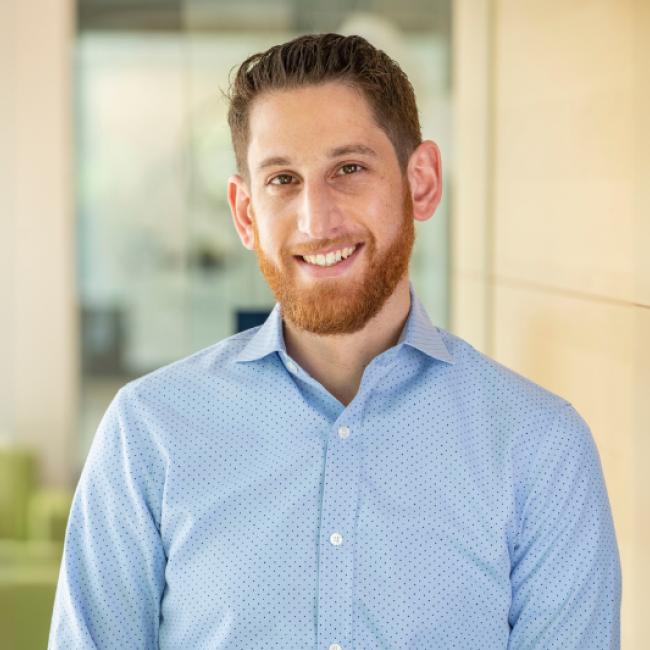
Jonathan D. Herman, MD, PhD, has received the UC Early Career Research Excellence Grant. A member of the infectious diseases division, he also received a $5.4 million grant earlier this year to advance H. pylori vaccine research in his lab. This second award will give him the runway he needs to conduct even more groundbreaking research.
“I was really excited when I heard I received this award,” Dr. Herman said. “It’s really going to allow us to start new directions and really go in ways that I think are going to be exciting for immunology and for translational medicine.”
Herman’s lab focuses on understanding how the immune system works and how to use insights from it to develop new vaccines and treatments for infectious diseases. He and his team study B cells — the subtype of immune cells that makes antibodies in response to pathogens — and employ computational and systems biology approaches to understand how that works in human patients and vaccine recipients.
“A lot of immunology research focuses on the part of the immune system that we study, antibodies and B cells, and happens in model systems such as animal models,” he said. “Because we’re limited in terms of the type of experiments we can do in humans, we’re trying to use advanced computational approaches to get those insights from a very different type of experiment.”
That work involves, for example, the measurement of thousands of characteristics about a single patient’s antibody response to a vaccine, then using machine learning to try to understand the features that distinguish whether or not they responded to it, or the clinical symptoms they would develop if they were infected with the pathogen. The UC Early Career Research Excellence Award will help his lab develop a new technology to ask these questions further upstream in the immune system by measuring the antigen specificity of B cells to hundreds of thousands of antigens at a time.
“This is going to allow us to really study these things in humans as opposed to the need to work in mice and non-human primates,” he said. “With this new method, we’re going to try to understand new targets that are protective for malaria vaccine development.”
This stands to benefit patients in two different ways. First, the technology will open up a new field of immunology study, one that could apply to many different infections, vaccines and disease processes. Second, it will specifically improve the field’s understanding of the key targets in malaria that could lead to highly effective, long-lasting vaccines — a significant need, as the two World Health Organization (WHO)-approved vaccines currently approved for malaria offer only partial, short-term protection.
“Our hope is that by using these new approaches, we can find new targets that will let us make vaccines that last for years and are much better at protecting people,” Herman said.
Herman has been fascinated by global health and infectious diseases since he was an undergraduate, when he began working on malaria and drug development. He focused his curiosity on immunology after realizing that no drug works to protect a person from infection without the help of the immune system.
“Now, my passion is really figuring out how we can harness the human immune system to protect people from infections,” he said. “Clinically, I work as an infectious disease doctor, day in and day out taking care of people who are suffering from very severe bacterial, viral and fungal infection. My hope is that by using these techniques, we can alleviate all that and put myself out of a job!”
Herman feels that the Department of Medicine is the right place for him to conduct his research because of its support for physician-scientists like him. He shared that while he was in the process of remodeling his lab, other faculty gave him tissue culture space and other materials to ensure that he could keep his work going.
“The UCLA Department of Medicine has very much helped develop my career as a physician-scientist,” he said. “Being able to balance clinical work, research and fundraising while staying on the cutting edge of research in the current age is challenging, and the DoM has been a supportive environment that’s allowed our program to flourish.”
Meet the Researchers
- Assistant Professor-in-Residence, Infectious Diseases