
How do our bodies age? This dermatologist is looking to skin for answers
As a dermatologist at the West Los Angeles VA Medical Center, Amy Vandiver sees the effects of aging written across her patients’ skin.
In her older patients, those changes are not simply cosmetic. Damage that accumulates over decades can make aging skin more vulnerable to disease and injury, with consequences for health, function and quality of life.
That vulnerability also makes skin an unusually revealing window into aging. Because its changes are visible and the tissue itself is relatively easy to access, Vandiver can use it to investigate larger questions: What makes a tissue biologically old? What drives that process? And could some of those changes eventually be prevented, slowed or reversed?
Vandiver’s work also inspires a question among the skincare-curious: How does this dermatologist and aging expert protect her own skin?
Her routine is strikingly simple.
At night, Vandiver uses a prescription retinoid. In the morning, she uses a lipid-based moisturizer and mineral sunscreen. She occasionally adds a vitamin C serum. And roughly every other year, she undergoes a laser treatment.
Of those interventions, the least glamorous is the one she emphasizes most.
"In the skin, sunscreen is our best anti-aging drug," said Vandiver, an assistant professor of dermatology at the David Geffen School of Medicine at UCLA.
It's a surprisingly restrained answer for an aging researcher — but that restraint is the point. She holds her own bathroom shelf to the same evidence standard she uses in her lab.
Vandiver is a member of the UCLA Broad Stem Cell Research Center and the UCLA Health Jonsson Comprehensive Cancer Center. In her clinical practice, she cares for patients with age-related skin diseases, while her lab examines the cellular damage accumulating beneath the surface. She is particularly focused on mutations in the DNA carried by mitochondria and uses stem cells to investigate how that damage changes the way skin cells behave.
Age — what's in a number?
Vandiver poses the hypothetical of two 78-year-old patients.
One is working, traveling and living independently. The other may be experiencing cognitive impairment, cancer or physical limitations that dramatically restrict daily life. Though they share the same numerical age, their bodies tell different stories.
Scientists have been developing biological aging clocks in an effort to measure some of that difference — to quantify how physiologically “old” or “young” a person’s body is relative to another person of the same chronological age.
But Vandiver said the picture may be more complicated still: There may not be one age for the entire body.
A person could have strong muscles, good metabolic health and sharp cognition while simultaneously developing thin, fragile skin and numerous skin cancers. Someone else might show significant aging in other organ systems while their skin remains comparatively healthy.
Increasingly, Vandiver said, aging research is showing that individual tissues may even require their own clocks.
And few tissues make that idea as tangible as skin.
Skin keeps a record of what it has endured
Questions about aging have long compelled Vandiver, who entered medical school aspiring to become a geriatrician. During her Ph.D. training, however, as she looked for an accessible population of stem cells to study, she began to see the potential of skin: It was easy to sample and accumulated many of the molecular hallmarks of aging at exceptionally high levels.
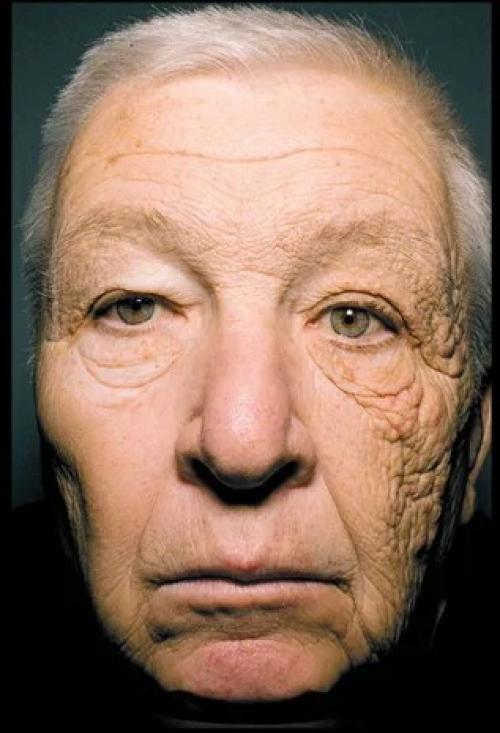
It also offers a natural experiment.
Skin on a person's face and forearms might experience decades of sunlight and other environmental exposures, while skin on a relatively protected area — such as the upper inner arm — experiences much less.
The DNA is the same. The exposures aren't.
By comparing those tissues within the same person, researchers can ask which changes are intrinsic to getting older and which are accelerated by external damage.
That distinction matters because skin spends a lifetime confronting the environment. Sun-exposed skin, in particular, carries substantial acquired genetic and cellular damage.
With age, the epidermis, or outermost skin layer, thins, and the quality of the padded dermal layer declines, impacting the skin's ability to maintain its role as a barrier. Those changes can affect not only appearance but also how well the skin performs its basic functions. And that weakened barrier may have consequences beyond the skin: Emerging research suggests it can contribute to inflammation in the bloodstream, potentially accelerating aging in other tissues throughout the body.
For Vandiver, all of that makes skin — our largest body system — an unusually revealing place to investigate what environmental stress leaves behind.
Following damage into the mitochondria
To understand that damage, Vandiver's lab is looking inside cells at the mitochondria — the structures generations of students have learned to describe as the “powerhouse of the cell.”
Mitochondria carry a small genome of their own, and a single cell can contain hundreds to thousands of copies of it. Mitochondrial DNA has become central to Vandiver’s work.
Compared with the DNA housed in a cell's nucleus, the mitochondrial genome accumulates mutations relatively rapidly. Sun-exposed skin contains a high burden of mitochondrial mutations, and similar changes appear in other stressed, diseased or aging tissues.
In that sense, mitochondrial DNA may serve partly as a record of what a cell has endured.
But Vandiver is interested in a bigger question: Is that damage merely a marker of aging, or does it help drive the changes that make cells and tissues function differently?
Because some mitochondrial genomes can carry harmful mutations while others within a given cell remain healthy, Vandiver is examining how the accumulation of mutated copies may interfere with cell function.
If researchers can learn how cells eliminate damaged mitochondrial genomes, they may be able to shift the balance back toward a healthier mitochondrial population.
“It's not only this readout of genetic damage, it’s something we can intervene on,” Vandiver said.
Building aging skin in the lab
To test how mitochondrial damage changes cell behavior, Vandiver's lab uses stem cells, which are unusually amenable to manipulating mitochondrial mutations.
Her team has developed stem cell clones with the same nuclear DNA but very different levels of age-associated mitochondrial mutations, which they can then turn into several kinds of cells, including skin cells.
By comparing those cells, the researchers can ask whether the same mitochondrial damage affects cell types differently — and whether they can help a tissue eliminate damaged mitochondria or the dysfunctional cells that carry them.
Vandiver's lab combines these stem cell models with genomic sequencing and 3D skin cultures — lab-grown models that mimic the structure of human skin — to begin answering those questions.
The eventual goal is larger than making skin look younger. It’s understanding how molecular damage accumulates, how that damage changes the behavior of cells and tissues and, ultimately, whether some of those changes can be prevented, slowed or reversed.
The science-backed aging intervention
For now, there remains a striking gap between the sophistication of the questions scientists are asking about aging and the certainty with which anti-aging supplements, serums and devices are marketed.
While Vandiver can appreciate the enthusiasm for trending treatments, such as red-light therapy, she notes that most don’t have standardized studies or enough evidence to make them part of her own routine.
Instead, her approach rests on a principle drawn from both her clinic and her laboratory: Pay attention to the damage we already understand. For skin, that means protecting it from ultraviolet radiation, supporting a barrier that grows more vulnerable with age and choosing well-studied interventions over the newest fad product.
Someday, Vandiver may help reveal whether tissues can be coaxed into clearing the damage they've accumulated over a lifetime. Until then, one of the most powerful tools available remains annoyingly ordinary.
A bottle of sunscreen.
Contact

Meet the Researchers
- Assistant Professor, Dermatology