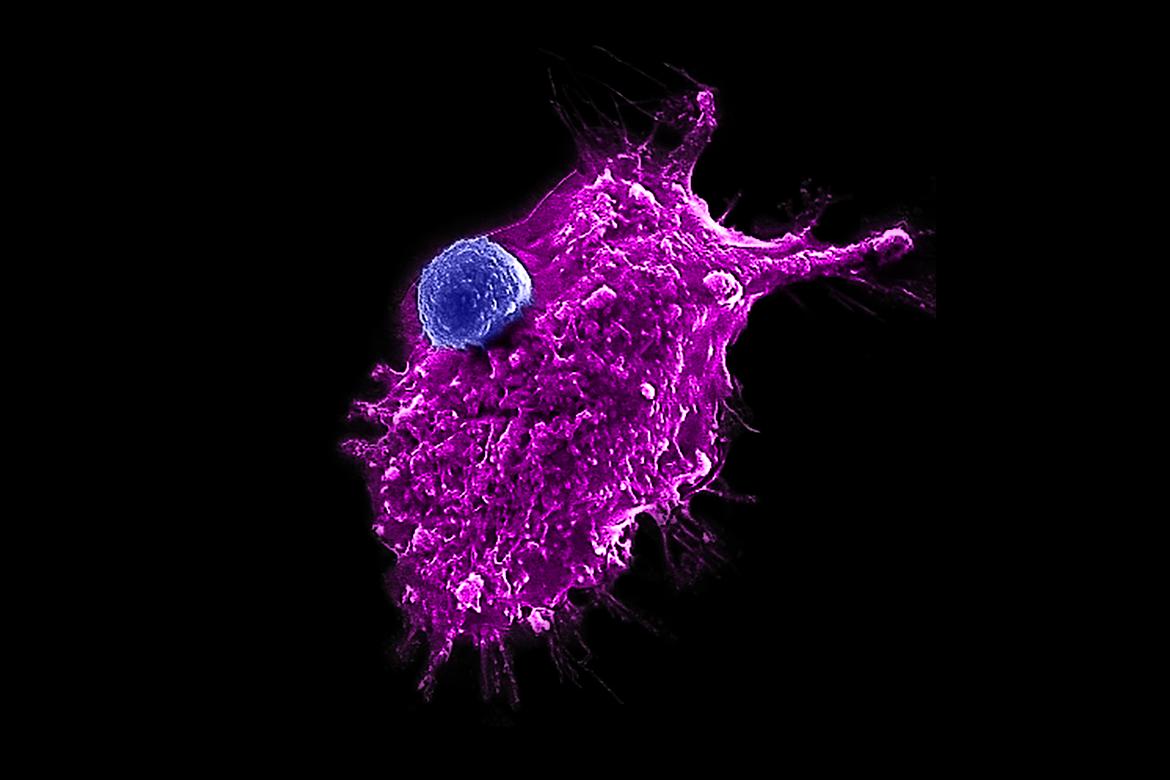
Cancer & Immunotherapy
Our members are developing more effective immunotherapies, creating cutting-edge cancer vaccines and improving the safety of targeted treatments.

Overview
ImmunotherapyA type of treatment that uses the body's own immune system to fight cancer, infections and other diseases. This approach has revolutionized cancer care and is also being applied in experimental treatments for HIV, lupus and other conditions.ImmunotherapyA type of treatment that uses the body's own immune system to fight cancer, infections and other diseases. This approach has revolutionized cancer care and is also being applied in experimental treatments for HIV, lupus and other conditions. has been one of medicine's great success stories. Yet today, it works for only a fraction of patients — leaving 70 to 80 percent without access to its benefits. Our researchers are determined to close that gap.
At the UCLA Broad Stem Cell Research Center, scientists are engineering next-generation immunotherapies that transform how we fight leukemia, melanoma, brain tumors, prostate cancer and other life-threatening diseases. By combining stem cell biology, gene editingA type of gene therapy that works by delivering genetic material that can directly edit pieces of DNA within a cell. This changes the instructions the DNA encodes for, which ultimately results in an increase or decrease in the production of a certain protein and the restoration of proper cell function.gene editingA type of gene therapy that works by delivering genetic material that can directly edit pieces of DNA within a cell. This changes the instructions the DNA encodes for, which ultimately results in an increase or decrease in the production of a certain protein and the restoration of proper cell function. and cellular engineering, our researchers are developing therapies designed to be more precise, more durable and accessible to more patients.
From CAR-T cells that target previously untreatable tumors to “off-the-shelf” immune cell therapies and personalized cancer vaccines, UCLA investigators are advancing discoveries from the laboratory into early-phase clinical trials through close partnerships with the UCLA Health Jonsson Comprehensive Cancer Center and our clinical teams.
Explore the breakthroughs, the researchers behind them, and the clinical advances shaping the future of cancer treatment.
Our Goals
-
The challenge: Today's most powerful immunotherapies are custom-manufactured for each patient — a process that is expensive, time-consuming and difficult to scale. Reaching more patients requires new manufacturing strategies and renewable cell sources that don't depend on collecting cells from each patient being treated.
Our researchers’ solutions:
- Engineering a renewable source of cancer-fighting immune cells derived from donated blood stem cellsA type of tissue-specific stem cells found in the blood and bone marrow that can form various types of mature blood and immune cells. These cells play a crucial role in maintaining the body's blood supply and immune system by continuously producing new blood cells throughout a person's life.blood stem cellsA type of tissue-specific stem cells found in the blood and bone marrow that can form various types of mature blood and immune cells. These cells play a crucial role in maintaining the body's blood supply and immune system by continuously producing new blood cells throughout a person's life. — cells that can be mass-produced, frozen and stored for immediate use, eliminating the lengthy and costly patient-by-patient manufacturing process that limits who can access treatment today
- Identifying the optimal designs for these engineered immune cells so they can penetrate solid tumor barriers — the key challenge in cancers like pancreatic, ovarian, breast and lung, where immunotherapyA type of treatment that uses the body's own immune system to fight cancer, infections and other diseases. This approach has revolutionized cancer care and is also being applied in experimental treatments for HIV, lupus and other conditions.immunotherapyA type of treatment that uses the body's own immune system to fight cancer, infections and other diseases. This approach has revolutionized cancer care and is also being applied in experimental treatments for HIV, lupus and other conditions. has historically struggled most
-
The challenge: Even when CAR-T therapies work, cancer can find ways to escape them — by shedding the proteins that immune cells are programmed to target, by creating a hostile tumor environment that exhausts and starves immune cells, or by erecting physical barriers that prevent treatment from reaching the tumor. Overcoming these obstacles is essential for extending the reach of CAR-T therapy beyond blood cancers to the solid tumors that affect the vast majority of patients.
Our researchers’ solutions:
- Engineering CAR-T cells that simultaneously target two cancer proteins rather than one, blocking the escape routes that cause patients to relapse — an approach that produced a 91% response rate in a Phase 1 clinical trialA research study conducted with human participants to evaluate the safety and effectiveness of new medical treatments, interventions, drugs or medical devices.clinical trialA research study conducted with human participants to evaluate the safety and effectiveness of new medical treatments, interventions, drugs or medical devices. for non-Hodgkin's lymphoma, with zero cases of neurotoxicity
- Developing "armored" CAR-T cells that dismantle the protective shield solid tumors use to block immune attacks — eliminating tumors in up to 88% of preclinical glioblastoma models where standard CAR-T therapy largely failed
- Equipping T cellsWhite blood cells that naturally fight against disease-causing invaders using specialized molecules, called receptors, on their cell surface. The receptors help T cells seek out and destroy virus-infected cells or cancer cells. T cellsWhite blood cells that naturally fight against disease-causing invaders using specialized molecules, called receptors, on their cell surface. The receptors help T cells seek out and destroy virus-infected cells or cancer cells. with a protected fuel source that tumor cells cannot steal, restoring their ability to survive and fight in the nutrient-depleted environment of solid tumors — an advance with implications for more than 500 active CAR-T clinical trials worldwide
-
The challenge: For some of the deadliest cancers — including glioblastoma, where median survival is under two years — conventional treatments can slow disease progression but rarely achieve lasting remission. Vaccines that teach the immune system to recognize and attack a patient's specific tumor offer a fundamentally different approach, with the potential to extend survival and reduce the risk of recurrence.
Our researchers’ solutions:
- Developing and advancing personalized cancer vaccines that expose a patient's own immune cells to their specific tumor, training the immune system to recognize and attack it — a strategy that has helped some glioblastoma patients survive more than five years beyond a terminal diagnosis
- Building three-dimensional, stem cell-derived tumor models that recreate the complexity of the human brain and its tumor environment, enabling researchers to identify drug combinations that can overcome the resistance mechanisms glioblastoma uses to evade treatment
-
The challenge: Some of the most dangerous cancers remain out of reach — not because we haven't tried, but because they've been protected by biology we couldn't crack. Some harbor proteins that resist every drug we've designed. Others build physical shields that block treatment from ever reaching the tumor. Breakthroughs here require entirely new approaches.
Our researchers’ solutions:
- Developing the first drug capable of targeting IGF2BP3, a protein long considered "undruggable" that drives aggressive leukemia, brain tumors, sarcomas and breast cancers — a discovery more than a decade in the making that could open a new class of treatments across multiple cancer types
- Launching a first-in-human clinical trialA research study conducted with human participants to evaluate the safety and effectiveness of new medical treatments, interventions, drugs or medical devices.clinical trialA research study conducted with human participants to evaluate the safety and effectiveness of new medical treatments, interventions, drugs or medical devices. of a radiotheranostic therapy that acts as a guided missile — simultaneously locating tumors at the molecular level and delivering targeted radiation to destroy them — an approach that eliminated nearly all tumors in preclinical models of osteosarcoma, a rare bone cancer that primarily affects children and young adults, with potential applications in glioblastoma and pancreatic cancer
-
The challenge: Earlier detection dramatically improves outcomes, particularly in pediatric cancers where minimally invasive approaches are critical.
Our researchers’ solutions:
- Advancing and clinically translating liquid biopsy diagnostic methods that leverage nanotechnologies to enable early detection of pediatric cancers
-
The challenge: Cancer disproportionately affects older adults — and cancer treatment can accelerate the aging process itself, leaving survivors facing health challenges that outlast their diagnosis. Understanding this two-way relationship is essential for developing treatments that don't just extend life, but preserve quality of life.
Our researchers’ solutions:
- Investigating how cancer therapies such as chemotherapy trigger accelerated biological aging in survivors, and developing interventions — including exercise and targeted drugs — that can slow or reverse those effects
- Recruiting older cancer patients and survivors to clinical trials that translate basic science discoveries about aging into practical treatments, with a focus on ensuring that the fastest-growing segment of cancer patients is represented in research
One Immunotherapy Platform, Multiple Cancers
Many immunotherapies are engineered to target a single type of cancer. UCLA researchers are taking a different approach, developing a platform that can be adapted to target different cancers using CAR-NKT cells — natural killer T (NKT) cells equipped with chimeric antigen receptors, or CARs, that help them recognize and attack specific cancer targets.
The NKT cells are produced from blood-forming stem cells isolated from donated umbilical cord blood, allowing them to be mass-produced, frozen and stored for immediate use. This off-the-shelf approach could eliminate the need to manufacture a personalized treatment for each patient, potentially allowing therapies to reach patients faster and at a significantly lower cost.
By changing what the CAR-NKT cells are designed to target, researchers can adapt the platform to different tumors without starting from scratch each time. Explore how our researchers are adapting this experimental therapeutic approach for different cancers:


Patient Story
UCLA clinical trial offers hope for lymphoma patients
At 39, actor Hirotaka Matsunaga was diagnosed with non-Hodgkin's lymphoma. Over the next four years, he endured two courses of chemotherapy in combination with immunotherapy, but the cancer always returned. After receiving treatment in the first-in-human clinical trial of a cutting-edge CAR-T cell therapy, he's now in remission and doesn't have any symptoms at all. "I feel like myself again," Matsunaga said.
Research Highlights

Immunotherapy for aggressive tumors
Center scientists develop an immunotherapy that shrinks or eliminates tumors in 90% of clinical trial participants with a rare and aggressive form of skin cancer.

A renewable source of cancer-fighting T cells
Our researchers discover a technique that could produce a continuous supply of T cells, a key step toward developing more widely accessible T cell therapies.

Fighting cancer with SSRIs
UCLA scientists find that a widely used antidepressant drug could help the immune system fight cancer and suppress tumor growth.

Collaborating to combat ovarian cancer
UCLA scientists are collaborating to develop a novel immunotherapy they hope will transform ovarian cancer treatment and reduce the likelihood of recurrence at a fraction of the cost of current therapies.

AI model predicts survival outcomes for cancer patients
UCLA researchers develop an AI model that successfully predicts patient outcomes across multiple cancer types by examining the gene expression patterns of epigenetic factors.

CAR-T cell immunotherapy shows promise
Center investigators develop a dual target CAR-T cell therapy for non-Hodgkin’s lymphoma that has successfully treated 10 of 11 patients in a Phase 1 clinical trial.

Novel treatment for advanced sarcomas
Center investigators launch a Phase 1 clinical trial of a stem cell immunotherapy for metastatic sarcoma.

Creatine may help fight cance
Center investigators discover that creatine supplementation slowed tumor growth and increased activation of immune cells in mouse models.


Related News


Media Coverage
LA shines its lights on ovarian cancer
Icon

Larchmont Buzz
Scientists create off-the-shelf T cell cancer therapy from cord blood
Icon
Drug Discovery News
Antoni Ribas receives 2026 ESMO lifetime achievement award
Icon
OncoDaily